
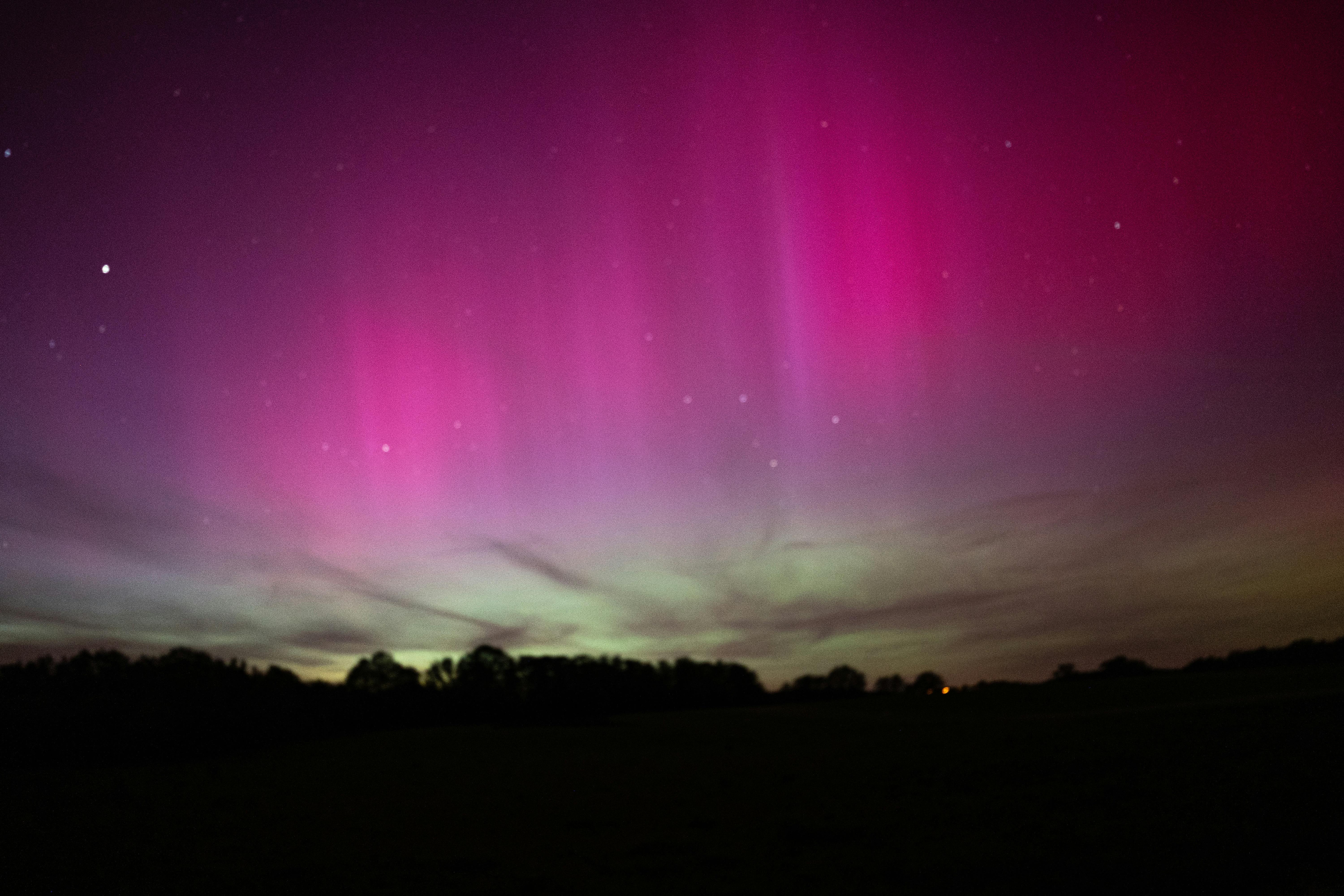
Low orbits are not empty. A thin trace of atmosphere extends far above where flight is possible, and solar activity changes how thick that trace is, with direct consequences for spacecraft.
Why there is atmosphere at orbital altitude
The atmosphere does not stop at a boundary. Its density falls off steadily with height and remains measurable hundreds of miles up.
At those altitudes the density is minute compared with sea level, but a spacecraft passing through it at orbital speed still experiences a continuous retarding force.
That drag gradually reduces orbital energy, lowering the orbit over time, which is why satellites in low orbit require periodic reboosting to remain in place.
How a geomagnetic storm changes the density
Energy deposited into the upper atmosphere during a storm heats it, particularly at high latitudes where the coupling with the solar wind is strongest.
Heated gas expands, so the whole upper atmosphere puffs outward and layers that were formerly higher up are pushed to greater altitudes.
A satellite at a fixed height therefore finds itself in denser air than before, and the drag it experiences can rise substantially within hours.
Why the effect compounds during a storm
Increased drag lowers the orbit, and density increases further at lower altitudes, so the process accelerates rather than stabilizing.
A spacecraft with limited propulsion may be unable to counteract the loss quickly enough, particularly if it is newly launched and still raising its orbit.
Storms have caused loss of recently deployed satellites for exactly this reason, when they were still in the low parking orbits used before final positioning.
What it does to tracking
Operators predict the future position of every tracked object in orbit, and those predictions depend on modeling drag accurately.
During a storm the atmosphere departs sharply from its modeled state, and predicted positions drift from actual ones across the catalog at once.
Collision avoidance depends on knowing where objects will be, so uncertainty rises for thousands of objects simultaneously and takes days to resolve after conditions settle.
Why the eleven-year cycle matters for planning
Solar activity waxes and wanes over a cycle of roughly eleven years, and the upper atmosphere is systematically denser near the peak than near the minimum.
Mission planners account for this when choosing orbital altitude and fuel reserves, since a satellite launched near solar maximum will consume more propellant to hold station.
The same effect works usefully in reverse, since defunct hardware and debris in low orbits decay faster during active periods, clearing some of it without intervention.